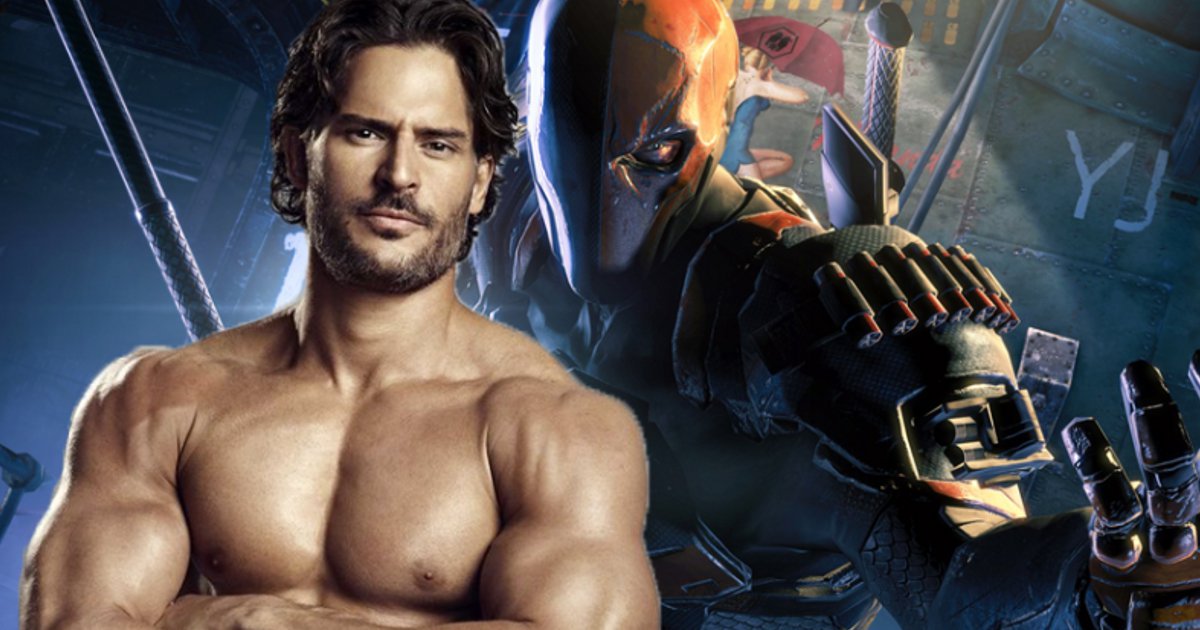
In a podcast talking about Dungeons & Dragons, Joe Manganiello talks training for the role of Deathstroke (h/t to reddit for the text).
Greg: You’re going to be playing Deathstroke in the new Batman which is a bad guy right?
Joe: Yes.
Greg: I’m not a comic person. The one part of nerdom that I never really got into. So I only learn about it from the movies.
Joe: I can turn you on to some really good ones if you would like.
Greg: Nice, but I even realized your D&D campaign is kind of like research for playing an evil guy a little bit right?
Joe: Yeah, to an extent. I mean, you know, the character of Deathstroke is very specific. The building of that character is very similar. Looking at someone as evil or a villain is really not accurate.
Greg: Because they think they’re the heroes.
Joe: Well, they’ve been affected in a certain way. I mean you can look at a character like Batman. For example Batman had this tragedy, this personal tragedy, he lost these loved ones and swore this would never happen to anyone else again. He became this vigilante with very questionable tactics at times.
On the converse if you read the comic books Deathstroke is a character that’s not dissimilar to that origin story. He lost a loved one and rather than swearing it would never happen again there was like a bit of numbness. His change was that he became this assassin for hire and wound up being fine with just murdering everyone in sight for the right price.
Greg: Right.
Joe: So there’s a very fine line between those two characters. I think if either one crossed that line they would turn into the other very easily. So it’s almost this mirror reflection of what those choices could’ve been for Bruce Wayne had he gone a different direction.
Greg: I think a lot of the Christopher Nolan movies especially kind of explore like.. Is he crossing the line? Is this actually too much?
Joe: Yeah. So, you know, in my mind you could say Deathstroke’s a villain. There’s definitely a way to look at him that way. But there’s a way to look at him as an anti-hero. Or just someone who’s figuring things out in his own way. Or trying to work something out over the course of this 2 hour movie.
Greg: Not unlike a rogue dragonborn paladin. (Joe’s D&D character)
Shelly: Batman better not slap him. You know what’s going to happen. (laughs) (Reference to Joe’s character being slapped by a gnome in D&D)
Greg: He’ll burn down the bar. (Joe’s character’s response to being being slapped by a gnome in D&D)
Joe: It better not be a little person who slaps Deathstroke in the face or he’s going to lose his mind.
Shelly: So how much freedom do you have if you’re playing a comic book character that has a backstory that’s been told throughout. How much freedom do you have to put your own spin on these characters.
Joe: That’s a good question. I think it’s probably case by case. The real answer is we’ll see once we get on the ground. I’m somebody that likes to start preparing way ahead of time. So I’ve read almost all the comic books involving him. Just to get the information out of them. Some of them are useful. Some of them are not going to be useful. Because ultimately the script—that’s my text. I have to play that.
I started katana training recently. Like live sword training and I started meeting with various martial arts teachers and discussing with them. “Ok, so what are the most offensive styles of martial arts”. Ones where you’re not waiting for someone to attack you but ones where you’re looking to make the attack. Then what are the most deadly ones? Where are the scrolls, the ancient Japanese scrolls that have these really deadly techniques that you don’t teach to the average student out the street? Something that only somebody who would go looking for it that are really really bad, you know, are dangerous. Like, what are those?
Ok, so now what are the stances? What are like some really unorthodox stances that someone who learns say Ninjutsu would stand in? Ok, so now what if that person lost an eye? If that person lost an eye how would they then alter the stance so that you would have better peripheral vision. What would that look like? So then you start cooking, and then you start building a story. Kind of outside-in. That’s like a very physical way to build a story.
Then on the other side of it, like I said, I’m looking at the script rather than the comic books. I mean the comic books are giving me a good general kind of area of what we’re talking about. Where this characters located. But the script is really like, you know. Because they might change the canon. There’s been like 3 or 4 different ways that he’s lost his eye. Are we doing one of those? Or are we doing it a completely new way? Like, I need to play that.
Greg: That’s interesting. So what’s it been like actually training with live steel? Has it been nerve wracking or..?
Joe: Nah, it’s great. I love it. I love that stuff.
Greg: I’d be so nervous that I’d be slicing myself. I guess obviously they’re not sharp.
Joe: No they’re sharp. Live sharp swords. I mean they have these reeds and sometimes even bamboo in the center of these reeds that they soak for a couple of days. When they dry out they kind of have the consistency of a neck or a limb. They set them up and you practice with the live swords your cutting technique. Slashing and then you have to switch your footing and go from the other side. Then you have to kind of get it out of your mind this idea that strength is what’s going to cut this thing. That it’s really like a focusing of the energy and like a quick flick.
Once you do that, then you start really cooking. Then you learn the other strokes. Up-strokes, down-strokes, then there’s even like a cut where you come straight out of the sheath or saya. You cut right as you’re coming out.
Shelly: Did Nathan show you the dojo that we have downstairs? Because we really do have a dojo.
Joe: No?
Shelly: You can practice.
Joe: Are there swords in it?
Shelly: There’s foam swords at my desk
Joe: (laughs)
Greg: Like Nerf swords, that doesn’t count.
Shelly: They’re better than that. Really authentic. They do hurt.
Greg: And you’re trainer is here so i mean—
Joe: He is here yeah. Do you have a two-handed great foam sword? (laughs).
Greg: We’re going to get one made.
Shelly: A little duct tape I can work that out.
Greg: Well thank you so much man it’s been great. Can’t wait to talk to you all the time.
Joe: Thanks. I’ll be back.