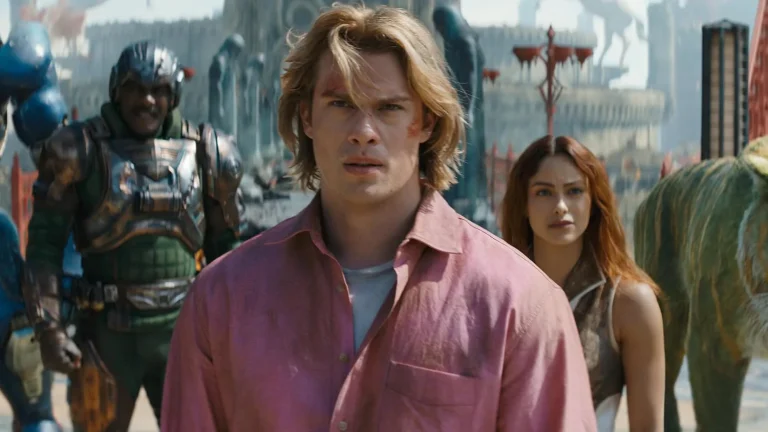
A Forbes headline this week declared Masters of the Universe “Set For Sequel Despite Dismal Box Office.”
There’s just one problem: nothing in the article actually reports a sequel being greenlit.
It’s a case of a headline writing a check the reporting underneath it doesn’t cash, and the real numbers point the other way.

What’s Actually Been Announced: Nothing
Read past the headline and the sequel “news” evaporates into inference.
The piece’s own language is hedged that the film “seems set to” get a sequel. The entire basis is a post-credits tease introducing He-Man’s twin sister, Princess Adora (She-Ra), plus director Travis Knight telling ComicBook.com that “there is a world that exists outside the frame of the film.”
That’s a franchise setup and a director’s wish list, the same “we’d love to do more” every would-be tentpole plants in its final reel.
It is not a greenlight. Amazon MGM has announced no Masters of the Universe sequel. “Set for a sequel” implies a decision that hasn’t been made.
The Numbers Argue Against A Greenlight, Not For One
Here’s the irony: Forbes‘ own reporting lays out exactly why a confident sequel order would be a surprise.
By its figures, Masters of the Universe has grossed just $89.9 million worldwide against a reported ~$170 million cost, needing roughly $340 million to break even, leaving it a quarter of a billion dollars short.
It opened to $29.4 million and second place, then collapsed to fifth in its second weekend.
It hasn’t stopped sliding since.
The film now sits around $56 million domestic heading into its third weekend, shedding theaters fast. It has yet to hit $100 million worldwide, as of Friday.
Those aren’t the numbers a studio typically rushes to sequelize on theatrical merit.
The Streaming Argument Is Real — But It’s Not “Set”
To be fair, the article’s underlying argument is a legitimate one, and worth taking seriously.
Amazon’s model doesn’t judge a film on box office alone; it treats theatrical as a “critical first moment” to build awareness of a title that then drives Prime Video subscriptions.
The strongest evidence: Amazon skipped French theaters entirely, sending Masters of the Universe straight to Prime there, because France’s 17-month theatrical-to-streaming window would make it old news by the time a sequel arrived.
That’s a smart read on Amazon’s strategy. But notice what it actually supports: a sequel that could be justified on streaming logic, not one that’s “set.”
“It might happen if it performs on Prime” is the opposite of a done deal. The honest version of the headline is “Masters of the Universe Could Get A Streaming-Driven Sequel,” which is a much softer — and accurate — claim.
Amazon’s Own Slate Exposes The Spin
Here’s where the “theatrical never really mattered” framing falls apart: it’s contradicted by how Amazon actually behaves.
The studio knows exactly how to send a movie straight to Prime when it wants to. It did it with Road House, which skipped theaters and became one of the platform’s most-watched films.
It’s doing it with the Henry Cavill-led Voltron, a reported $150 million-plus tentpole confirmed at Amazon’s May Upfront to bypass cinemas entirely for Prime Video.
So when Amazon did put Masters of the Universe in over 3,000 theaters and spent an estimated $170 million doing it, that wasn’t a studio indifferent to theatrical.
That’s a studio that wanted a theatrical hit. You don’t spend tentpole money on a wide release for a movie you’ve already decided will live or die on streaming.
And the clearest tell is the timing. Voltron — same studio, same older-skewing nostalgia-IP profile as Masters of the Universe — was pulled from a theatrical release and routed straight to Prime right as Masters of the Universe and Mortal Kombat II were stumbling at the box office.
If theatrical results genuinely didn’t matter to Amazon, that pivot makes no sense. A bomb that “doesn’t count” wouldn’t scare a studio off putting its next comparable title in theaters. This one apparently did.
Read it together and the spin inverts: Amazon’s behavior shows box office matters to them quite a lot. “Streaming was always the plan” is the story you tell after the theatrical bet doesn’t pay off, not the plan you signal by spending $170 million to fill 3,000 screens.

Why The Distinction Matters
This isn’t nitpicking. “Set for a sequel” tells readers a decision has been made; it hasn’t.
A post-credits tease plus a streaming strategy is a case for a sequel, not a confirmation of one, and dressing inference as an announcement is how box office reality gets blurred.
The reality here: a movie a quarter-billion in the red theatrically, still falling, with a possible streaming-era second life that remains entirely unconfirmed.
If and when Amazon actually orders a Masters of the Universe sequel, that’ll be the story. It hasn’t yet.